BitcoinWorld Why is the price of Bitcoin different on different apps? Why Is the Price of Bitcoin Different on Different Apps? Bitcoin showing a different price on different apps is one of the first things new users notice and can’t explain – it seems like there should be one single global price. There isn’t, and …
BitcoinWorld
Why is the price of Bitcoin different on different apps?
Why Is the Price of Bitcoin Different on Different Apps?
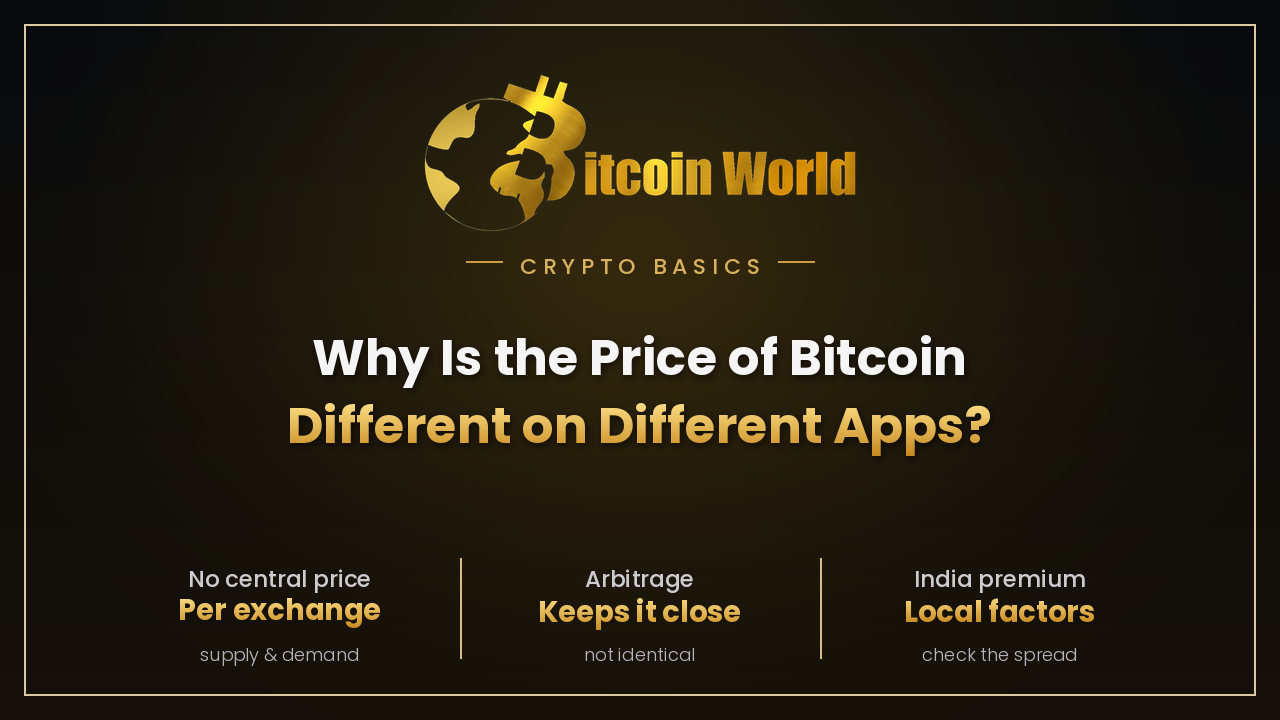
Bitcoin showing a different price on different apps is one of the first things new users notice and can’t explain – it seems like there should be one single global price. There isn’t, and there’s a clear reason why. Each exchange sets its own price based on its own supply and demand, and that’s before accounting for local market factors, fees, and how each app displays the number. This article explains why prices diverge, how arbitrage keeps them close, why Indian exchanges often show a premium, and how to read the price you’re actually being quoted.
Why Is the Price of Bitcoin Different on Different Apps?
The Bitcoin price differs on different apps because there is no single global exchange – each platform determines its own price based on the buy and sell orders on that specific platform.
- No central price: Unlike a stock exchange with one official price, Bitcoin trades on hundreds of independent platforms simultaneously.
- Supply and demand per platform: Each exchange’s price reflects its own order book – the balance of buyers and sellers on that platform.
- Price discovery in real time: Prices update constantly, so two apps checked a second apart can show different numbers.
- Fees and spreads: Some apps show the mid-market price; others show the price you’d actually pay including their markup.
What Keeps Prices From Diverging Too Far?
A process called arbitrage ensures exchange prices stay broadly aligned even without coordination.
- Arbitrageurs profit from gaps: Traders buy on cheaper exchanges and sell on more expensive ones, closing price gaps.
- Fast and automated: Most arbitrage is done by bots operating in milliseconds.
- Liquidity matters: Larger, more liquid exchanges tend to set the benchmark price others track.
- Residual differences remain: Fees, transfer delays, and market-specific demand always leave some gap between platforms.
Why Do Indian Exchanges Often Show a Higher Bitcoin Price?
Users in India frequently notice that prices on Indian exchanges appear slightly higher than international references.
- The India premium: Local demand, limited rupee liquidity, and the friction of INR-to-crypto conversion can push domestic exchange prices above international benchmarks.
- Regulatory factors: Compliance costs and the 1% TDS on transactions are built into the effective price on Indian platforms.
- Exchange spread: Indian exchanges add their own bid-ask spread on top of the underlying price.
- Useful reference: Sites like CoinGecko or CoinMarketCap aggregate prices across exchanges, giving a global average useful for comparison.
How Should Indian Users Read the Price They’re Actually Paying?
The headline price shown on an app isn’t always what you pay.
- Ask/buy price: The price you pay when buying is typically slightly above the mid-market price.
- Bid/sell price: The price you receive when selling is typically slightly below the mid-market price.
- Effective cost: Add the exchange fee and any GST to see your true all-in cost per Bitcoin.
- Compare before buying: Checking two or three exchanges before a large purchase can save meaningful amounts on the spread.
Frequently Asked Questions
Why does the price of Bitcoin look different on CoinDCX vs Binance vs CoinMarketCap?
Each exchange runs its own order book with independent buyers and sellers, so prices naturally differ slightly. CoinMarketCap and similar sites show aggregated or reference prices across many exchanges, while individual platform prices reflect that platform’s specific supply and demand. Indian exchanges also factor in local demand, liquidity, and regulatory costs, which often results in a small premium over international benchmarks.
Is it possible to profit from Bitcoin being cheaper on one exchange?
In theory yes – this is called arbitrage. In practice, the speed of automated trading bots, transfer delays between exchanges, and the cost of moving funds between platforms mean most retail price gaps close before they can be manually exploited. For individual users, the meaningful takeaway is to compare exchange prices before a large purchase rather than trying to arbitrage across platforms.
Which app shows the “real” price of Bitcoin?
There’s no single “real” price – only the price on the specific platform where you’re trading. Reference sites like CoinGecko or CoinMarketCap show volume-weighted average prices across many exchanges, which serve as a useful global benchmark. The price that matters most to you is the one shown on your exchange at the moment you’re trading.
Conclusion: Why Price Differences Are Normal, Not a Problem
The reason Bitcoin’s price differs on different apps is straightforward once you understand that crypto has no central exchange – each platform runs independently, and local factors in India add their own layer. For Indian users, the practical response is to use a global reference price as a benchmark, factor in the full cost including fees and spread, and compare platforms before large purchases. Price variation isn’t a glitch; it’s how decentralized, global markets work.
This post Why is the price of Bitcoin different on different apps? first appeared on BitcoinWorld.